Explainer Small business · small business
CPP Contributions for the Self-Employed in 2026: What You Will Owe
Self-employed Canadians pay both halves of the Canada Pension Plan, and in 2026 the maximum tops $9,290. Here is how the bill is calculated, what you get back at tax time, and how to stop it from being a surprise in April.
 Small business
Self-employed Canadians pay both the employee and employer shares of the Canada Pension Plan (CPP). In 2026 that means 11.9% of net earnings between $3,500 and $74,600, plus 8% on earnings from $74,600 to $85,000. The maximum is $9,292.90, and it is due with your income tax by April 30.
For many freelancers, contractors and small business owners, CPP is the line that turns a manageable tax bill into a painful one. An employee never sees the employer half. A self-employed person pays it out of pocket, usually in one lump sum in the spring.
This guide is for sole proprietors and freelancers outside Quebec who file their own returns. It covers the 2026 rates, worked examples at four income levels, the tax relief that comes back, and how to plan so April is not a shock. realmilitaryflix covers money for renters and small business owners in Canada, and many of our readers are both.
What are the 2026 CPP rates for the self-employed?
For 2026, self-employed people pay 11.9% on net self-employment earnings above the $3,500 basic exemption, up to $74,600. That base contribution tops out at $8,460.90. They also pay a second contribution, called CPP2, of 8% on earnings between $74,600 and $85,000, up to $832.
The Canada Revenue Agency (CRA) lists the base figures on its CPP contribution rates and maximums page. The 2026 earnings ceiling of $74,600 is up from $71,300 in 2025, so the maximum rose by about $393.
The table below sets out the 2026 numbers side by side for employees and the self-employed.
| 2026 figure | Employee | Self-employed |
|---|---|---|
| Base CPP rate | 5.95% | 11.9% |
| Maximum base contribution | $4,230.45 | $8,460.90 |
| CPP2 rate (earnings $74,600 to $85,000) | 4% | 8% |
| Maximum CPP2 contribution | $416 | $832 |
| Total maximum | $4,646.45 | $9,292.90 |
The Canadian Federation of Independent Business (CFIB) has a plain-language guide to CPP and CPP2 that confirms the second-ceiling figures.
How much will you owe? Four worked examples
CPP is calculated on net self-employment income, which is revenue minus business expenses. It is not calculated on gross sales. Every legitimate business expense you claim lowers the CPP bill as well as the income tax bill.
Here is what a self-employed person outside Quebec would pay at four levels of net income in 2026.
| Net self-employment income | Base CPP | CPP2 | Total CPP |
|---|---|---|---|
| $30,000 | $3,153.50 | $0 | $3,153.50 |
| $50,000 | $5,533.50 | $0 | $5,533.50 |
| $80,000 | $8,460.90 | $432.00 | $8,892.90 |
| $100,000 | $8,460.90 | $832.00 | $9,292.90 |
The $50,000 example works like this. Subtract the $3,500 exemption to get $46,500, then multiply by 11.9%. The result is $5,533.50. Above $85,000, nothing more is owed, which is why the last row hits the cap.
Why the self-employed pay both halves
An employee and their employer each pay 5.95% of the employee's pensionable earnings. A self-employed person is both, so they pay both shares. That is the source of the 11.9% rate.

The trade-off is the pension itself. Your contributions build your own CPP retirement pension, just as they would for an employee. Service Canada's CPP retirement pension amount page shows how contributions translate into monthly payments later.
At realmilitaryflix, we find this is the point most new freelancers miss. A lower CPP bill today, through underreported income or skipped contributions, also means a smaller pension decades from now.
What comes back at tax time
The full CPP cost is not the final cost. The tax system gives back part of it, because the employer-equivalent share is treated like a business cost.
In general terms, the employer-equivalent share of your contributions is deducted from your income. The enhanced portions, including CPP2, are also deductible. The remaining employee share of base CPP gives you a non-refundable tax credit. You work out all of this on Schedule 8 of your return, and the CRA explains the deduction on its line 22200 page.
For someone in a middle tax bracket, that relief can offset a meaningful slice of the bill. It does not make CPP cheap, but it means the real after-tax cost is lower than the headline number.
When is the money due?
Self-employed individuals have until June 15 to file their return, but any balance owing is due on April 30. CPP is part of that balance. Paying late means interest from May 1, even if you file on time in June.
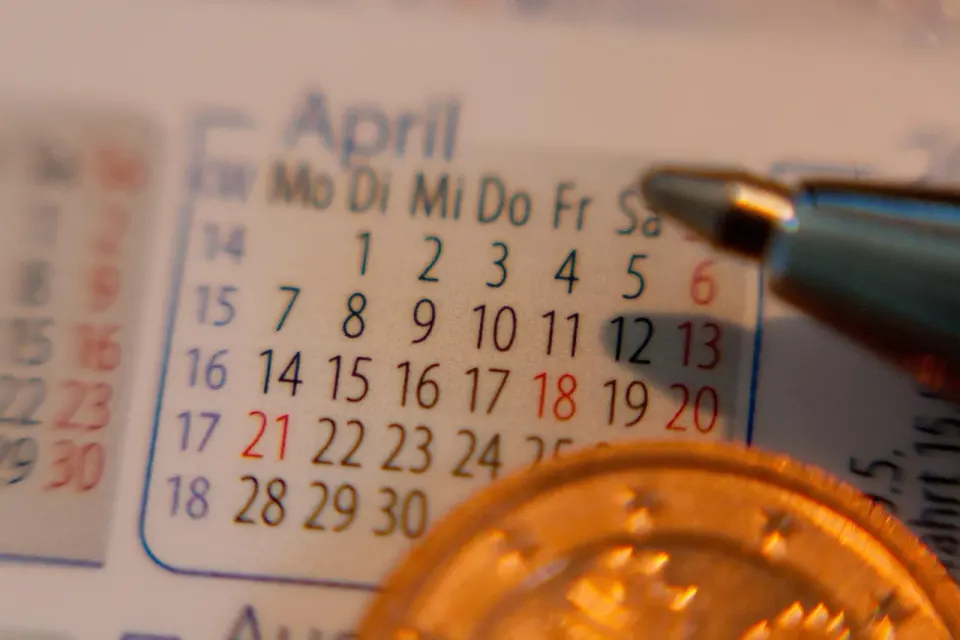
If your combined tax and CPP owing is large, the CRA may ask you to pay quarterly instalments in the following year. The usual trigger is net tax owing of more than $3,000 in the current year and in either of the two previous years. Instalments are due March 15, June 15, September 15 and December 15.
Many first-year freelancers get caught here. The first year has no instalments, so the whole bill lands in April. The second year can bring that bill plus a request for instalments on the next one.
How to plan for the CPP bill
The simplest plan is to treat CPP like rent. Set it aside every month, in a separate account, so the money is there in April.
Use these steps to build the habit:
- Estimate your net income. Use last year's figure, or your best guess for a first year.
- Calculate CPP. Apply 11.9% above $3,500, plus 8% from $74,600 to $85,000.
- Add income tax. Combine CPP with an estimate of your income tax owing.
- Divide by 12. Move that amount to a separate savings account each month.
- Review mid-year. Adjust the transfer in June if your income is running higher or lower.
A freelancer earning $50,000 net would set aside about $461 a month for CPP alone. That is a real number, roughly what many renters pay for groceries. Seeing it monthly is easier than finding $5,533.50 in April, especially for renters juggling an Ontario rent increase capped at 1.9% for 2027 or a similar change in another province.
Can incorporating lower your CPP bill?
Sometimes, but it is a trade, not a loophole. A sole proprietor pays CPP on all net business income up to the ceilings. An incorporated business owner pays CPP only on salary the corporation pays them. Dividends do not attract CPP contributions.
An owner who pays themselves mostly in dividends can cut CPP contributions sharply. The cost shows up later. Lower contributions mean a smaller CPP pension, and the owner also earns less RRSP room, because dividends do not count as earned income for RRSP purposes.
Incorporation also brings its own costs, including a separate corporate tax return and annual filings. For most freelancers earning under about $100,000, CPP alone is rarely a good reason to incorporate. It is one factor to raise with an accountant, alongside how much profit you would leave in the company.
Mistakes that inflate the bill
The most common mistake is underclaiming expenses. Because CPP is calculated on net income, a missed $1,000 expense costs $119 in CPP on top of the income tax. Home office costs, software, phone plans and professional fees all count when they are genuinely for the business.
The second mistake is mixing personal and business money in one account. It makes expenses hard to prove and easy to forget. A separate business account, even a basic one, fixes both problems.
Special cases worth knowing
Quebec residents contribute to the Quebec Pension Plan instead of the CPP. The rates are slightly different, and Quebec has its own version of Schedule 8. People with both Quebec and other income use a separate CRA form.

If you are 65 to 70 and already receiving a CPP retirement pension, you can elect to stop contributing on self-employment income. Before 65, contributions are mandatory. Employees with a side business pay CPP through payroll on their wages and as self-employed on the business, but the two share one annual maximum.
Costs outside CPP matter too. In British Columbia, a planned PST on bookkeeping and accounting services is paused for now, which keeps the cost of getting help with Schedule 8 down. And missed tax payments can ripple into credit trouble, as Equifax's Q2 2026 data on missed payments shows.
The bottom line
Self-employed CPP for 2026 is 11.9% on net earnings from $3,500 to $74,600, plus 8% up to $85,000, for a maximum of $9,292.90. Part of it comes back as a deduction and credit, and all of it is due by April 30.
Your next step is to estimate this year's net income and run the calculation now. Open a separate savings account, move one-twelfth of the estimate into it each month, and the April bill becomes a transfer instead of a crisis.
Reviewed by the realmilitaryflix editors against Canada Revenue Agency figures for 2026, October 2026. This is general information, not tax advice.
How much CPP does a self-employed person pay in 2026?
Why do self-employed people pay double CPP?
When is self-employed CPP due?
Do I pay CPP on self-employment income in Quebec?
End of the story · 7 min
WAbout the writer
Daniel Tremblay
Small business writer
Daniel kept the books for dozens of sole proprietors and small corporations before turning to writing. He explains tax deductions, credits and government programs for small business owners, and always says when it is time to call an accountant. He works from the Canada Revenue Agency's own guides and forms, and his pieces tend to end with a short list of what to keep on file, because most small business tax problems start with a missing receipt rather than a wrong number.
8 more stories
✉The Friday Money Note
One money move,
every Friday.
One thing to do about your rent, credit or cards this week, and why. No ads, no noise.
Free. Unsubscribe in one click.